They say you should answer when opportunity knocks. They say locked doors lead to adventure. The girl stood in front of the locked door, raised her fist, and knocked. It was a white door with a gold lock. There was a square sticker on the front of the door with the number 07 on it. Behind the door, she could hear movement. Scuffling. Zippering. She knocked again - louder. The scuffling did not stop. Someone was zippering - or maybe unzippering - ferociously.
She glanced around the hallway. It was a long hallway with an old tiled floor and white walls. Embedded within the walls were rows of locked doors, most of them unlabeled - not even with a number for an address.
A bit stumped, the girl turned away from door number 07 and leaned against the wall around the corner so she might think what to do. A minute or two passed. Still, no one opened the door. Each time the noises behind it got louder, the girl would hold her breath, bracing herself for the door being flung open - but it never happened. The noises merely returned to the zippering sounds.
Suddenly, she heard the tinkling of music begin to emanate from around the corner. Curious, she stepped lightly in the direction it was coming from, cautious not to make any noise. Then she saw it, more than heard. A slow fog of music, so tangible that if someone had asked what color it was, the girl would have answered that of course it was green, floated ethereally through the thin cracks between door number 07 and its door frame. She listened.
I will come to you...I will come to you...
Voices filled the music like a church choir.
The girl stood there for a moment. Then something - that thing that always knows when there is someone following you, even if you haven't turned around to look - that something inside her jumped, and she turned abruptly and near ran down the hall to the elevator. She jammed her finger into the elevator button and waited anxiously for eons before the elevator reached the tenth floor from the lobby. As soon as the doors opened, she jumped inside and pressed "door close," as though someone else was about to jump into the elevator with her.
Nine. Eight. Seven. Six. Five. Four. Three. Two. Lobby.
Quick, nervous steps to the open doors of freedom. A hurried "thank you!" thrown back over her shoulder to the man behind the front desk. And then she was through the doors and outside once more.
Once she could breathe again, the girl set off towards other adventures. Ones that didn't include long white hallways, zippering noises, or unidentifiable church music.
Showing posts with label adventure. Show all posts
Showing posts with label adventure. Show all posts
Friday, September 4, 2009


Sunday, May 3, 2009
The Misadventures Of A Rainy Friday
There are some days when the rain is so fierce that it is not rain at all, but rather like the all the lakes and rivers of the world are falling from the sky right on top of you. This past Friday was such a day.
SJ, D2, and I set off on our trek from Stern to Penn Station in a gray world with a damp breeze. On occasion, a few droplets of water would sprinkle onto our faces, but as we walked, these droplets became more like fully-grown drops and their descents occurred more frequently than "on occasion." By the time we were halfway there, the sky had begun to dump its entire watery contents onto New York City.
For those unfamiliar with summers in New York, they go something like this: Nice Day. Hot day. Humid day. Very humid day. Very, very humid day. So-humid-it's-like-walking-through-sticky-swaths-of-hot-cotton-candy day. Stormy day filled with drenching, torrential rains, blinding flashes of lightening, and thunder so deafening it sounds like the sky's going to crash to earth any minute. The next day is a beautiful one, and the cycle begins again.
Although we have yet to reach summer, the rain which drowned our feet that day might as well have been an early summer visitor. SJ and I each had umbrellas, but the wind had decided to whip mine backwards into a position that was utterly useless. My hair, my shirt, my skirt, and my feet became completely drenched. I only hoped the contents of the suitcase I was dragging were still dry.
By the time we three got to Penn Station, our clothes were sticking to us in that uncomfortable way that wet clothes do and our hair hung limp and bedraggled. I could feel water squishing around in my shoes.
In such circumstances, a person may tend to feel bogged down by her wetness. I certainly felt that way. We had only four minutes until our train and we still had to buy tickets, but for some reason I could only shuffle my feet slowly around the train station. Everything around me, in fact, was operating on a slower, wetter system.
There were long lines by each ticket machine, but somehow both SJ and I managed to get a turn. I got tickets for D2 and myself, but SJ's machine was broken. We had no time for her to try on my machine, however, so we ran to our platform with one minute to go, stumbled clumsily (and wetly) down the stairs, and threw ourselves onto the first car of the train just before the doors closed behind us.
The train was a Double Decker, and for a moment we stood there in wet confusion, wondering where the seats were.
"Shall we go up or down?" I finally managed through chattering teeth. The others must have been too wet or bewildered or both, for they each mumbled something that didn't sound very much like a suggestion.
"Up, then," I decided for them and we all traipsed up the steps, shivering in our sopping clothes. Unluckily, there was nowhere for us to sit, so we had to stand until we reached Jamaica. That was where we had to switch.
I called my dad at that point to ask if he was also on the train. Then we could get a ride home from the train station. He wasn't, but he said he was on another train that was also switching at Jamaica, so we decided to meet up.
At Jamaica, we met my father and made the switch easily. Our next train had seats for us, but not together, so D2 went to sit in one area while SJ sat in another. "We're getting off at ---" I told them just in case we got separated, for it was a different stop than the one we were originally going to on our first train. Then I stood for a bit near D2 because I felt too wet to sit, but SJ finally convinced me to sit with her. I suppose that was when things went a bit awry.
Looking back on it, I don't think D2 noticed that I was no longer standing near her. When the train pulled into our stop, SJ and I got off the train, along with my father. As I got off, I looked around for D2 but couldn't find her anywhere.
"Is someone supposed to get off the train with you?" asked a man from my community. I nodded.
"What's her name?"
"D2," I said.
He poked his head back in the train and called out, "D2!"
But no one answered and the doors were closing.
As the train pulled away, SJ and I both took out our phones to call her. And we both noticed we had text messages from her asking if we were going to the stop our initial train, before we met up with my father, was going to. We looked at each other.
"Oh no," we said.
"What happened to D2?" asked my father. "Was she sleeping?"
I shrugged. "What's the next stop?" I asked. "Because that's where she's going."
SJ called D2, who told her what the next stop was. Then, still wet (though it was no longer raining), we trudged to my father's car and drove off to pick up D2.
Ten minutes later, D2 was found and in the car with us.
"When we get home, we should all have hot chocolate," I said.
"Ooh, yes!" exclaimed D2.
When I was taking a writing class at Stern, my stories frequently ended in everyone going home to have hot chocolate. SJ called these "hot chocolate endings." I figured we all deserved our own hot chocolate ending.
As soon as we got home, SJ, D2, and I ran up to my room to change our clothes. SJ, already wearing a light blue shirt that was mostly dry, borrowed a pastel pink skirt from me. Looking in the mirror, she exclaimed, "I look like ice cream!"
D2, meanwhile, had discovered that an air mattress was piled on top of my bed so that the whole thing looked like the set of The Princess and the Pea. She climbed on top and curled up. SJ and I, thinking this was a fun activity, climbed up with her. But after a little while, I remembered about the hot chocolate.
"Oh yeah, let's go have hot chocolate!" said D2, when I reminded her.
We all slid off the piled mattresses and bounded down the stairs.
"Do we have any hot chocolate?" I asked Mavis, who, like most teenage boys, was lurking around in the kitchen. We usually did have hot chocolate, but I wasn't sure if we had gotten any since Pesach.
"I don't think so," said Mavis. "But you can always use Ovaltine!"
So we tried the Ovaltine. The issue with that was we couldn't use the instant hot water on our sink. We had to actually heat up milk.
"Maybe we shouldn't," I said, glancing around the kitchen that had various Shabbos cooking activities going on in it.
"Aw, why not?" asked D2. I hesitated.
"We can just warm it up in the microwave," suggested SJ.
"Okay," I said. "But...in what?"
"Mugs?"
"Can you microwave mugs?"
"Sure! We do it all the time in my house."
"Um...okay..."
So I got down three mugs.
"Wait, girls, why don't you try these?" suggested my father, taking down some Styrofoam cups. I felt more comfortable using those and took them readily. SJ and D2 each poured themselves a cup of milk and put the cups in the microwave.
I waited for them to be finished but D2 kept putting hers back in.
Finally, it was my turn. I decided that instead of putting it in and out a million times, I'd just put my cup in for a full four minutes.
I suppose no one really paid much attention to what I was doing, because no one stopped me. SJ and D2 were busy with their cups of hot chocolate. I waited around for my cup of milk to finish microwaving.
As I waited, I did other things. I went upstairs to get something. I talked to SJ and D2. Mavis and I spent some quality time bothering each other. And then I decided to check out how my cup of milk was doing.
The first thing I saw when I looked over at the microwave was a steamy door and lots of white behind it.
You know that feeling where you suddenly feel the blood rushing around in your head? Shabbos was in less than an hour and I thought for a moment that I had broken the microwave.
After my feet unstuck from the floor, I shakily pressed the "stop" button and pulled open the door. A large circle of white liquid lapped up against an empty Styrofoam cup in greeting.
When I panic, I am generally overcome with a slow-moving, intense calm. I suddenly know exactly what to do, and what I knew most of all in that situation was that there was no reason my mother had to come into the kitchen until the milk was all cleaned up.
I became almost devilish about it.
"Should I take a picture?" I asked SJ.
"Yes!" she grinned. "It's like illustrated milk!"
I giggled and ran to get my camera.
Before long, I had both taken a picture of the milky masterpiece and had cleaned it all up. It was quite easy to clean, too.
"Here, let's try again," said D2, grabbing hold of the Styrofoam cup.
I looked at her incredulously, nearly started laughing again, and shook my head.
"I think I've had enough experimenting with milk for now," I said.
So I did not get my hot chocolate ending.
But I did get some illustrated milk. Oh, and a great story.
SJ, D2, and I set off on our trek from Stern to Penn Station in a gray world with a damp breeze. On occasion, a few droplets of water would sprinkle onto our faces, but as we walked, these droplets became more like fully-grown drops and their descents occurred more frequently than "on occasion." By the time we were halfway there, the sky had begun to dump its entire watery contents onto New York City.
For those unfamiliar with summers in New York, they go something like this: Nice Day. Hot day. Humid day. Very humid day. Very, very humid day. So-humid-it's-like-walking-through-sticky-swaths-of-hot-cotton-candy day. Stormy day filled with drenching, torrential rains, blinding flashes of lightening, and thunder so deafening it sounds like the sky's going to crash to earth any minute. The next day is a beautiful one, and the cycle begins again.
Although we have yet to reach summer, the rain which drowned our feet that day might as well have been an early summer visitor. SJ and I each had umbrellas, but the wind had decided to whip mine backwards into a position that was utterly useless. My hair, my shirt, my skirt, and my feet became completely drenched. I only hoped the contents of the suitcase I was dragging were still dry.
By the time we three got to Penn Station, our clothes were sticking to us in that uncomfortable way that wet clothes do and our hair hung limp and bedraggled. I could feel water squishing around in my shoes.
In such circumstances, a person may tend to feel bogged down by her wetness. I certainly felt that way. We had only four minutes until our train and we still had to buy tickets, but for some reason I could only shuffle my feet slowly around the train station. Everything around me, in fact, was operating on a slower, wetter system.
There were long lines by each ticket machine, but somehow both SJ and I managed to get a turn. I got tickets for D2 and myself, but SJ's machine was broken. We had no time for her to try on my machine, however, so we ran to our platform with one minute to go, stumbled clumsily (and wetly) down the stairs, and threw ourselves onto the first car of the train just before the doors closed behind us.
The train was a Double Decker, and for a moment we stood there in wet confusion, wondering where the seats were.
"Shall we go up or down?" I finally managed through chattering teeth. The others must have been too wet or bewildered or both, for they each mumbled something that didn't sound very much like a suggestion.
"Up, then," I decided for them and we all traipsed up the steps, shivering in our sopping clothes. Unluckily, there was nowhere for us to sit, so we had to stand until we reached Jamaica. That was where we had to switch.
I called my dad at that point to ask if he was also on the train. Then we could get a ride home from the train station. He wasn't, but he said he was on another train that was also switching at Jamaica, so we decided to meet up.
At Jamaica, we met my father and made the switch easily. Our next train had seats for us, but not together, so D2 went to sit in one area while SJ sat in another. "We're getting off at ---" I told them just in case we got separated, for it was a different stop than the one we were originally going to on our first train. Then I stood for a bit near D2 because I felt too wet to sit, but SJ finally convinced me to sit with her. I suppose that was when things went a bit awry.
Looking back on it, I don't think D2 noticed that I was no longer standing near her. When the train pulled into our stop, SJ and I got off the train, along with my father. As I got off, I looked around for D2 but couldn't find her anywhere.
"Is someone supposed to get off the train with you?" asked a man from my community. I nodded.
"What's her name?"
"D2," I said.
He poked his head back in the train and called out, "D2!"
But no one answered and the doors were closing.
As the train pulled away, SJ and I both took out our phones to call her. And we both noticed we had text messages from her asking if we were going to the stop our initial train, before we met up with my father, was going to. We looked at each other.
"Oh no," we said.
"What happened to D2?" asked my father. "Was she sleeping?"
I shrugged. "What's the next stop?" I asked. "Because that's where she's going."
SJ called D2, who told her what the next stop was. Then, still wet (though it was no longer raining), we trudged to my father's car and drove off to pick up D2.
Ten minutes later, D2 was found and in the car with us.
"When we get home, we should all have hot chocolate," I said.
"Ooh, yes!" exclaimed D2.
When I was taking a writing class at Stern, my stories frequently ended in everyone going home to have hot chocolate. SJ called these "hot chocolate endings." I figured we all deserved our own hot chocolate ending.
As soon as we got home, SJ, D2, and I ran up to my room to change our clothes. SJ, already wearing a light blue shirt that was mostly dry, borrowed a pastel pink skirt from me. Looking in the mirror, she exclaimed, "I look like ice cream!"
D2, meanwhile, had discovered that an air mattress was piled on top of my bed so that the whole thing looked like the set of The Princess and the Pea. She climbed on top and curled up. SJ and I, thinking this was a fun activity, climbed up with her. But after a little while, I remembered about the hot chocolate.
"Oh yeah, let's go have hot chocolate!" said D2, when I reminded her.
We all slid off the piled mattresses and bounded down the stairs.
"Do we have any hot chocolate?" I asked Mavis, who, like most teenage boys, was lurking around in the kitchen. We usually did have hot chocolate, but I wasn't sure if we had gotten any since Pesach.
"I don't think so," said Mavis. "But you can always use Ovaltine!"
So we tried the Ovaltine. The issue with that was we couldn't use the instant hot water on our sink. We had to actually heat up milk.
"Maybe we shouldn't," I said, glancing around the kitchen that had various Shabbos cooking activities going on in it.
"Aw, why not?" asked D2. I hesitated.
"We can just warm it up in the microwave," suggested SJ.
"Okay," I said. "But...in what?"
"Mugs?"
"Can you microwave mugs?"
"Sure! We do it all the time in my house."
"Um...okay..."
So I got down three mugs.
"Wait, girls, why don't you try these?" suggested my father, taking down some Styrofoam cups. I felt more comfortable using those and took them readily. SJ and D2 each poured themselves a cup of milk and put the cups in the microwave.
I waited for them to be finished but D2 kept putting hers back in.
Finally, it was my turn. I decided that instead of putting it in and out a million times, I'd just put my cup in for a full four minutes.
I suppose no one really paid much attention to what I was doing, because no one stopped me. SJ and D2 were busy with their cups of hot chocolate. I waited around for my cup of milk to finish microwaving.
As I waited, I did other things. I went upstairs to get something. I talked to SJ and D2. Mavis and I spent some quality time bothering each other. And then I decided to check out how my cup of milk was doing.
The first thing I saw when I looked over at the microwave was a steamy door and lots of white behind it.
You know that feeling where you suddenly feel the blood rushing around in your head? Shabbos was in less than an hour and I thought for a moment that I had broken the microwave.
After my feet unstuck from the floor, I shakily pressed the "stop" button and pulled open the door. A large circle of white liquid lapped up against an empty Styrofoam cup in greeting.
When I panic, I am generally overcome with a slow-moving, intense calm. I suddenly know exactly what to do, and what I knew most of all in that situation was that there was no reason my mother had to come into the kitchen until the milk was all cleaned up.
I became almost devilish about it.
"Should I take a picture?" I asked SJ.
"Yes!" she grinned. "It's like illustrated milk!"
I giggled and ran to get my camera.
Before long, I had both taken a picture of the milky masterpiece and had cleaned it all up. It was quite easy to clean, too.
"Here, let's try again," said D2, grabbing hold of the Styrofoam cup.
I looked at her incredulously, nearly started laughing again, and shook my head.
"I think I've had enough experimenting with milk for now," I said.
So I did not get my hot chocolate ending.
But I did get some illustrated milk. Oh, and a great story.
Tuesday, March 17, 2009
Monday, March 31, 2008
My Blogiversary party! (part two)
For entertainment, I bring you (major thanks to SJ for sharing this story with me)...
(from this website)
(from this website)
The Green Door
by O'Henry
Suppose you should be walking down Broadway after dinner, with ten
minutes allotted to the consummation of your cigar while you are
choosing between a diverting tragedy and something serious in the way
of vaudeville. Suddenly a hand is laid upon your arm. You turn to
look into the thrilling eyes of a beautiful woman, wonderful in
diamonds and Russian sables. She thrusts hurriedly into your hand
an extremely hot buttered roll, flashes out a tiny pair of scissors,
snips off the second button of your overcoat, meaningly ejaculates
the one word, "parallelogram!" and swiftly flies down a cross street,
looking back fearfully over her shoulder.
That would be pure adventure. Would you accept it? Not you. You
would flush with embarrassment; you would sheepishly drop the roll
and continue down Broadway, fumbling feebly for the missing button.
This you would do unless you are one of the blessed few in whom the
pure spirit of adventure is not dead.
True adventurers have never been plentiful. They who are set down in
print as such have been mostly business men with newly invented
methods. They have been out after the things they wanted--golden
fleeces, holy grails, lady loves, treasure, crowns and fame. The
true adventurer goes forth aimless and uncalculating to meet and
greet unknown fate. A fine example was the Prodigal Son--when he
started back home.
Half-adventurers--brave and splendid figures--have been numerous.
>From the Crusades to the Palisades they have enriched the arts of
history and fiction and the trade of historical fiction. But each
of them had a prize to win, a goal to kick, an axe to grind, a race
to run, a new thrust in tierce to deliver, a name to carve, a crow to
pick--so they were not followers of true adventure.
In the big city the twin spirits Romance and Adventure are always
abroad seeking worthy wooers. As we roam the streets they slyly peep
at us and challenge us in twenty different guises. Without knowing
why, we look up suddenly to see in a window a face that seems to
belong to our gallery of intimate portraits; in a sleeping
thoroughfare we hear a cry of agony and fear coming from an empty and
shuttered house; instead of at our familiar curb, a cab-driver
deposits us before a strange door, which one, with a smile, opens for
us and bids us enter; a slip of paper, written upon, flutters down to
our feet from the high lattices of Chance; we exchange glances of
instantaneous hate, affection and fear with hurrying strangers in the
passing crowds; a sudden douse of rain--and our umbrella may be
sheltering the daughter of the Full Moon and first cousin of the
Sidereal System; at every corner handkerchiefs drop, fingers beckon,
eyes besiege, and the lost, the lonely, the rapturous, the
mysterious, the perilous, changing clues of adventure are slipped
into our fingers. But few of us are willing to hold and follow them.
We are grown stiff with the ramrod of convention down our backs. We
pass on; and some day we come, at the end of a very dull life, to
reflect that our romance has been a pallid thing of a marriage or
two, a satin rosette kept in a safe-deposit drawer, and a lifelong
feud with a steam radiator.
Rudolf Steiner was a true adventurer. Few were the evenings on which
he did not go forth from his hall bedchamber in search of the
unexpected and the egregious. The most interesting thing in life
seemed to him to be what might lie just around the next corner.
Sometimes his willingness to tempt fate led him into strange paths.
Twice he had spent the night in a station-house; again and again he
had found himself the dupe of ingenious and mercenary tricksters; his
watch and money had been the price of one flattering allurement. But
with undiminished ardour he picked up every glove cast before him
into the merry lists of adventure.
One evening Rudolf was strolling along a crosstown street in the
older central part of the city. Two streams of people filled the
sidewalks--the home-hurrying, and that restless contingent that
abandons home for the specious welcome of the thousand-candle-power
~table d'hote~.
The young adventurer was of pleasing presence, and moved serenely and
watchfully. By daylight he was a salesman in a piano store. He wore
his tie drawn through a topaz ring instead of fastened with a stick
pin; and once he had written to the editor of a magazine that
"Junie's Love Test" by Miss Libbey, had been the book that had most
influenced his life.
During his walk a violent chattering of teeth in a glass case on the
sidewalk seemed at first to draw his attention (with a qualm), to a
restaurant before which it was set; but a second glance revealed the
electric letters of a dentist's sign high above the next door. A
giant negro, fantastically dressed in a red embroidered coat, yellow
trousers and a military cap, discreetly distributed cards to those of
the passing crowd who consented to take them.
This mode of dentistic advertising was a common sight to Rudolf.
Usually he passed the dispenser of the dentist's cards without
reducing his store; but tonight the African slipped one into his hand
so deftly that he retained it there smiling a little at the
successful feat.
When he had travelled a few yards further he glanced at the card
indifferently. Surprised, he turned it over and looked again with
interest. One side of the card was blank; on the other was written
in ink three words, "The Green Door." And then Rudolf saw, three
steps in front of him, a man throw down the card the negro had given
him as he passed. Rudolf picked it up. It was printed with the
dentist's name and address and the usual schedule of "plate work" and
"bridge work" and specious promises of "painless" operations.
The adventurous piano salesman halted at the corner and considered.
Then he crossed the street, walked down a block, recrossed and joined
the upward current of people again. Without seeming to notice the
negro as he passed the second time, he carelessly took the card that
was handed him. Ten steps away he inspected it. In the same
handwriting that appeared on the first card "The Green Door" was
inscribed upon it. Three or four cards were tossed to the pavement
by pedestrians both following and leading him. These fell blank side
up. Rudolf turned them over. Every one bore the printed legend of
the dental "parlours."
Rarely did the arch sprite Adventure need to beckon twice to Rudolf
Steiner, his true follower. But twice it had been done, and the
quest was on.
Rudolf walked slowly back to where the giant negro stood by the case
of rattling teeth. This time as he passed he received no card. In
spite of his gaudy and ridiculous garb, the Ethiopian displayed a
natural barbaric dignity as he stood, offering the cards suavely to
some, allowing others to pass unmolested. Every half minute he
chanted a harsh, unintelligible phrase akin to the jabber of car
conductors and grand opera. And not only did he withhold a card this
time, but it seemed to Rudolf that he received from the shining and
massive black countenance a look of cold, almost contemptuous
disdain.
The look stung the adventurer. He read in it a silent accusation
that he had been found wanting. Whatever the mysterious written
words on the cards might mean, the black had selected him twice from
the throng for their recipient; and now seemed to have condemned him
as deficient in the wit and spirit to engage the enigma.
Standing aside from the rush, the young man made a rapid estimate of
the building in which he conceived that his adventure must lie. Five
stories high it rose. A small restaurant occupied the basement.
The first floor, now closed, seemed to house millinery or furs. The
second floor, by the winking electric letters, was the dentist's.
Above this a polyglot babel of signs struggled to indicate the abodes
of palmists, dressmakers, musicians and doctors. Still higher up
draped curtains and milk bottles white on the window sills proclaimed
the regions of domesticity.
After concluding his survey Rudolf walked briskly up the high flight
of stone steps into the house. Up two flights of the carpeted
stairway he continued; and at its top paused. The hallway there was
dimly lighted by two pale jets of gas one--far to his right, the
other nearer, to his left. He looked toward the nearer light and saw,
within its wan halo, a green door. For one moment he hesitated; then
he seemed to see the contumelious sneer of the African juggler of
cards; and then he walked straight to the green door and knocked
against it.
Moments like those that passed before his knock was answered measure
the quick breath of true adventure. What might not be behind those
green panels! Gamesters at play; cunning rogues baiting their traps
with subtle skill; beauty in love with courage, and thus planning to
be sought by it; danger, death, love, disappointment, ridicule--any
of these might respond to that temerarious rap.
A faint rustle was heard inside, and the door slowly opened. A girl
not yet twenty stood there, white-faced and tottering. She loosed
the knob and swayed weakly, groping with one hand. Rudolf caught her
and laid her on a faded couch that stood against the wall. He closed
the door and took a swift glance around the room by the light of a
flickering gas jet. Neat, but extreme poverty was the story that he
read.
The girl lay still, as if in a faint. Rudolf looked around the room
excitedly for a barrel. People must be rolled upon a barrel who--no,
no; that was for drowned persons. He began to fan her with his hat.
That was successful, for he struck her nose with the brim of his
derby and she opened her eyes. And then the young man saw that hers,
indeed, was the one missing face from his heart's gallery of intimate
portraits. The frank, grey eyes, the little nose, turning pertly
outward; the chestnut hair, curling like the tendrils of a pea vine,
seemed the right end and reward of all his wonderful adventures. But
the face was wofully thin and pale.
The girl looked at him calmly, and then smiled.
"Fainted, didn't I?" she asked, weakly. "Well, who wouldn't? You
try going without anything to eat for three days and see!"
"Himmel!" exclaimed Rudolf, jumping up. "Wait till I come back."
He dashed out the green door and down the stairs. In twenty minutes
he was back again, kicking at the door with his toe for her to open
it. With both arms he hugged an array of wares from the grocery and
the restaurant. On the table he laid them--bread and butter, cold
meats, cakes, pies, pickles, oysters, a roasted chicken, a bottle of
milk and one of redhot tea.
"This is ridiculous," said Rudolf, blusteringly, "to go without
eating. You must quit making election bets of this kind. Supper is
ready." He helped her to a chair at the table and asked: "Is there
a cup for the tea?" "On the shelf by the window," she answered.
When he turned again with the cup he saw her, with eyes shining
rapturously, beginning upon a huge Dill pickle that she had rooted
out from the paper bags with a woman's unerring instinct. He took it
from her, laughingly, and poured the cup full of milk. "Drink that
first" he ordered, "and then you shall have some tea, and then a
chicken wing. If you are very good you shall have a pickle
to-morrow. And now, if you'll allow me to be your guest we'll have
supper."
He drew up the other chair. The tea brightened the girl's eyes and
brought back some of her colour. She began to eat with a sort of
dainty ferocity like some starved wild animal. She seemcd to regard
the young man's presence and the aid he had rendered her as a natural
thing--not as though she undervalued the conventions; but as one
whose great stress gave her the right to put aside the artificial for
the human. But gradually, with the return of strength and comfort,
came also a sense of the little conventions that belong; and she
began to tell him her little story. It was one of a thousand such as
the city yawns at every day--the shop girl's story of insufficient
wages, further reduced by "fines" that go to swell the store's
profits; of time lost through illness; and then of lost positions,
lost hope, and--the knock of the adventurer upon the green door.
But to Rudolf the history sounded as big as the Iliad or the crisis
in "Junie's Love Test."
"To think of you going through all that," he exclaimed.
"It was something fierce," said the girl, solemnly.
"And you have no relatives or friends in the city?"
"None whatever."
"I am all alone in the world, too," said Rudolf, after a pause.
"I am glad of that," said the girl, promptly; and somehow it pleased
the young man to hear that she approved of his bereft condition.
Very suddenly her eyelids dropped and she sighed deeply.
"I'm awfully sleepy," she said, "and I feel so good."
Then Rudolf rose and took his hat. "I'll say good-night. A long
night's sleep will be fine for you."
He held out his hand, and she took it and said "good-night." But
her eyes asked a question so eloquently, so frankly and pathetically
that he answered it with words.
"Oh, I'm coming back to-morrow to see how you are getting along. You
can't get rid of me so easily."
Then, at the door, as though the way of his coming had been so much
less important than the fact that he had come, she asked: "How did
you come to knock at my door?"
He looked at her for a moment, remembering the cards, and felt a
sudden jealous pain. What if they had fallen into other hands as
adventurous as his? Quickly he decided that she must never know the
truth. He would never let her know that he was aware of the strange
expedient to which she had been driven by her great distress.
"One of our piano tuners lives in this house," he said. "I knocked
at your door by mistake."
The last thing he saw in the room before the green door closed was
her smile.
At the head of the stairway he paused and looked curiously about him.
And then he went along the hallway to its other end; and, coming
back, ascended to the floor above and continued his puzzled
explorations. Every door that he found in the house was painted
green.
Wondering, he descended to the sidewalk. The fantastic African was
still there. Rudolf confronted him with his two cards in his hand.
"Will you tell me why you gave me these cards and what they mean?"
he asked.
In a broad, good-natured grin the negro exhibited a splendid
advertisement of his master's profession.
"Dar it is, boss," he said, pointing down the street. "But I 'spect
you is a little late for de fust act."
Looking the way he pointed Rudolf saw above the entrance to a theatre
the blazing electric sign of its new play, "The Green Door."
"I'm informed dat it's a fust-rate show, sah," said the negro. "De
agent what represents it pussented me with a dollar, sah, to
distribute a few of his cards along with de doctah's. May I offer
you one of de doctah's cards, sah?"
At the corner of the block in which he lived Rudolf stopped for a
glass of beer and a cigar. When he had come out with his lighted
weed he buttoned his coat, pushed back his hat and said, stoutly, to
the lamp post on the corner:
"All the same, I believe it was the hand of Fate that doped out the
way for me to find her."
Which conclusion, under the circumstances, certainly admits Rudolf
Steiner to the ranks of the true followers of Romance and Adventure.
by O'Henry
Suppose you should be walking down Broadway after dinner, with ten
minutes allotted to the consummation of your cigar while you are
choosing between a diverting tragedy and something serious in the way
of vaudeville. Suddenly a hand is laid upon your arm. You turn to
look into the thrilling eyes of a beautiful woman, wonderful in
diamonds and Russian sables. She thrusts hurriedly into your hand
an extremely hot buttered roll, flashes out a tiny pair of scissors,
snips off the second button of your overcoat, meaningly ejaculates
the one word, "parallelogram!" and swiftly flies down a cross street,
looking back fearfully over her shoulder.
That would be pure adventure. Would you accept it? Not you. You
would flush with embarrassment; you would sheepishly drop the roll
and continue down Broadway, fumbling feebly for the missing button.
This you would do unless you are one of the blessed few in whom the
pure spirit of adventure is not dead.
True adventurers have never been plentiful. They who are set down in
print as such have been mostly business men with newly invented
methods. They have been out after the things they wanted--golden
fleeces, holy grails, lady loves, treasure, crowns and fame. The
true adventurer goes forth aimless and uncalculating to meet and
greet unknown fate. A fine example was the Prodigal Son--when he
started back home.
Half-adventurers--brave and splendid figures--have been numerous.
>From the Crusades to the Palisades they have enriched the arts of
history and fiction and the trade of historical fiction. But each
of them had a prize to win, a goal to kick, an axe to grind, a race
to run, a new thrust in tierce to deliver, a name to carve, a crow to
pick--so they were not followers of true adventure.
In the big city the twin spirits Romance and Adventure are always
abroad seeking worthy wooers. As we roam the streets they slyly peep
at us and challenge us in twenty different guises. Without knowing
why, we look up suddenly to see in a window a face that seems to
belong to our gallery of intimate portraits; in a sleeping
thoroughfare we hear a cry of agony and fear coming from an empty and
shuttered house; instead of at our familiar curb, a cab-driver
deposits us before a strange door, which one, with a smile, opens for
us and bids us enter; a slip of paper, written upon, flutters down to
our feet from the high lattices of Chance; we exchange glances of
instantaneous hate, affection and fear with hurrying strangers in the
passing crowds; a sudden douse of rain--and our umbrella may be
sheltering the daughter of the Full Moon and first cousin of the
Sidereal System; at every corner handkerchiefs drop, fingers beckon,
eyes besiege, and the lost, the lonely, the rapturous, the
mysterious, the perilous, changing clues of adventure are slipped
into our fingers. But few of us are willing to hold and follow them.
We are grown stiff with the ramrod of convention down our backs. We
pass on; and some day we come, at the end of a very dull life, to
reflect that our romance has been a pallid thing of a marriage or
two, a satin rosette kept in a safe-deposit drawer, and a lifelong
feud with a steam radiator.
Rudolf Steiner was a true adventurer. Few were the evenings on which
he did not go forth from his hall bedchamber in search of the
unexpected and the egregious. The most interesting thing in life
seemed to him to be what might lie just around the next corner.
Sometimes his willingness to tempt fate led him into strange paths.
Twice he had spent the night in a station-house; again and again he
had found himself the dupe of ingenious and mercenary tricksters; his
watch and money had been the price of one flattering allurement. But
with undiminished ardour he picked up every glove cast before him
into the merry lists of adventure.
One evening Rudolf was strolling along a crosstown street in the
older central part of the city. Two streams of people filled the
sidewalks--the home-hurrying, and that restless contingent that
abandons home for the specious welcome of the thousand-candle-power
~table d'hote~.
The young adventurer was of pleasing presence, and moved serenely and
watchfully. By daylight he was a salesman in a piano store. He wore
his tie drawn through a topaz ring instead of fastened with a stick
pin; and once he had written to the editor of a magazine that
"Junie's Love Test" by Miss Libbey, had been the book that had most
influenced his life.
During his walk a violent chattering of teeth in a glass case on the
sidewalk seemed at first to draw his attention (with a qualm), to a
restaurant before which it was set; but a second glance revealed the
electric letters of a dentist's sign high above the next door. A
giant negro, fantastically dressed in a red embroidered coat, yellow
trousers and a military cap, discreetly distributed cards to those of
the passing crowd who consented to take them.
This mode of dentistic advertising was a common sight to Rudolf.
Usually he passed the dispenser of the dentist's cards without
reducing his store; but tonight the African slipped one into his hand
so deftly that he retained it there smiling a little at the
successful feat.
When he had travelled a few yards further he glanced at the card
indifferently. Surprised, he turned it over and looked again with
interest. One side of the card was blank; on the other was written
in ink three words, "The Green Door." And then Rudolf saw, three
steps in front of him, a man throw down the card the negro had given
him as he passed. Rudolf picked it up. It was printed with the
dentist's name and address and the usual schedule of "plate work" and
"bridge work" and specious promises of "painless" operations.
The adventurous piano salesman halted at the corner and considered.
Then he crossed the street, walked down a block, recrossed and joined
the upward current of people again. Without seeming to notice the
negro as he passed the second time, he carelessly took the card that
was handed him. Ten steps away he inspected it. In the same
handwriting that appeared on the first card "The Green Door" was
inscribed upon it. Three or four cards were tossed to the pavement
by pedestrians both following and leading him. These fell blank side
up. Rudolf turned them over. Every one bore the printed legend of
the dental "parlours."
Rarely did the arch sprite Adventure need to beckon twice to Rudolf
Steiner, his true follower. But twice it had been done, and the
quest was on.
Rudolf walked slowly back to where the giant negro stood by the case
of rattling teeth. This time as he passed he received no card. In
spite of his gaudy and ridiculous garb, the Ethiopian displayed a
natural barbaric dignity as he stood, offering the cards suavely to
some, allowing others to pass unmolested. Every half minute he
chanted a harsh, unintelligible phrase akin to the jabber of car
conductors and grand opera. And not only did he withhold a card this
time, but it seemed to Rudolf that he received from the shining and
massive black countenance a look of cold, almost contemptuous
disdain.
The look stung the adventurer. He read in it a silent accusation
that he had been found wanting. Whatever the mysterious written
words on the cards might mean, the black had selected him twice from
the throng for their recipient; and now seemed to have condemned him
as deficient in the wit and spirit to engage the enigma.
Standing aside from the rush, the young man made a rapid estimate of
the building in which he conceived that his adventure must lie. Five
stories high it rose. A small restaurant occupied the basement.
The first floor, now closed, seemed to house millinery or furs. The
second floor, by the winking electric letters, was the dentist's.
Above this a polyglot babel of signs struggled to indicate the abodes
of palmists, dressmakers, musicians and doctors. Still higher up
draped curtains and milk bottles white on the window sills proclaimed
the regions of domesticity.
After concluding his survey Rudolf walked briskly up the high flight
of stone steps into the house. Up two flights of the carpeted
stairway he continued; and at its top paused. The hallway there was
dimly lighted by two pale jets of gas one--far to his right, the
other nearer, to his left. He looked toward the nearer light and saw,
within its wan halo, a green door. For one moment he hesitated; then
he seemed to see the contumelious sneer of the African juggler of
cards; and then he walked straight to the green door and knocked
against it.
Moments like those that passed before his knock was answered measure
the quick breath of true adventure. What might not be behind those
green panels! Gamesters at play; cunning rogues baiting their traps
with subtle skill; beauty in love with courage, and thus planning to
be sought by it; danger, death, love, disappointment, ridicule--any
of these might respond to that temerarious rap.
A faint rustle was heard inside, and the door slowly opened. A girl
not yet twenty stood there, white-faced and tottering. She loosed
the knob and swayed weakly, groping with one hand. Rudolf caught her
and laid her on a faded couch that stood against the wall. He closed
the door and took a swift glance around the room by the light of a
flickering gas jet. Neat, but extreme poverty was the story that he
read.
The girl lay still, as if in a faint. Rudolf looked around the room
excitedly for a barrel. People must be rolled upon a barrel who--no,
no; that was for drowned persons. He began to fan her with his hat.
That was successful, for he struck her nose with the brim of his
derby and she opened her eyes. And then the young man saw that hers,
indeed, was the one missing face from his heart's gallery of intimate
portraits. The frank, grey eyes, the little nose, turning pertly
outward; the chestnut hair, curling like the tendrils of a pea vine,
seemed the right end and reward of all his wonderful adventures. But
the face was wofully thin and pale.
The girl looked at him calmly, and then smiled.
"Fainted, didn't I?" she asked, weakly. "Well, who wouldn't? You
try going without anything to eat for three days and see!"
"Himmel!" exclaimed Rudolf, jumping up. "Wait till I come back."
He dashed out the green door and down the stairs. In twenty minutes
he was back again, kicking at the door with his toe for her to open
it. With both arms he hugged an array of wares from the grocery and
the restaurant. On the table he laid them--bread and butter, cold
meats, cakes, pies, pickles, oysters, a roasted chicken, a bottle of
milk and one of redhot tea.
"This is ridiculous," said Rudolf, blusteringly, "to go without
eating. You must quit making election bets of this kind. Supper is
ready." He helped her to a chair at the table and asked: "Is there
a cup for the tea?" "On the shelf by the window," she answered.
When he turned again with the cup he saw her, with eyes shining
rapturously, beginning upon a huge Dill pickle that she had rooted
out from the paper bags with a woman's unerring instinct. He took it
from her, laughingly, and poured the cup full of milk. "Drink that
first" he ordered, "and then you shall have some tea, and then a
chicken wing. If you are very good you shall have a pickle
to-morrow. And now, if you'll allow me to be your guest we'll have
supper."
He drew up the other chair. The tea brightened the girl's eyes and
brought back some of her colour. She began to eat with a sort of
dainty ferocity like some starved wild animal. She seemcd to regard
the young man's presence and the aid he had rendered her as a natural
thing--not as though she undervalued the conventions; but as one
whose great stress gave her the right to put aside the artificial for
the human. But gradually, with the return of strength and comfort,
came also a sense of the little conventions that belong; and she
began to tell him her little story. It was one of a thousand such as
the city yawns at every day--the shop girl's story of insufficient
wages, further reduced by "fines" that go to swell the store's
profits; of time lost through illness; and then of lost positions,
lost hope, and--the knock of the adventurer upon the green door.
But to Rudolf the history sounded as big as the Iliad or the crisis
in "Junie's Love Test."
"To think of you going through all that," he exclaimed.
"It was something fierce," said the girl, solemnly.
"And you have no relatives or friends in the city?"
"None whatever."
"I am all alone in the world, too," said Rudolf, after a pause.
"I am glad of that," said the girl, promptly; and somehow it pleased
the young man to hear that she approved of his bereft condition.
Very suddenly her eyelids dropped and she sighed deeply.
"I'm awfully sleepy," she said, "and I feel so good."
Then Rudolf rose and took his hat. "I'll say good-night. A long
night's sleep will be fine for you."
He held out his hand, and she took it and said "good-night." But
her eyes asked a question so eloquently, so frankly and pathetically
that he answered it with words.
"Oh, I'm coming back to-morrow to see how you are getting along. You
can't get rid of me so easily."
Then, at the door, as though the way of his coming had been so much
less important than the fact that he had come, she asked: "How did
you come to knock at my door?"
He looked at her for a moment, remembering the cards, and felt a
sudden jealous pain. What if they had fallen into other hands as
adventurous as his? Quickly he decided that she must never know the
truth. He would never let her know that he was aware of the strange
expedient to which she had been driven by her great distress.
"One of our piano tuners lives in this house," he said. "I knocked
at your door by mistake."
The last thing he saw in the room before the green door closed was
her smile.
At the head of the stairway he paused and looked curiously about him.
And then he went along the hallway to its other end; and, coming
back, ascended to the floor above and continued his puzzled
explorations. Every door that he found in the house was painted
green.
Wondering, he descended to the sidewalk. The fantastic African was
still there. Rudolf confronted him with his two cards in his hand.
"Will you tell me why you gave me these cards and what they mean?"
he asked.
In a broad, good-natured grin the negro exhibited a splendid
advertisement of his master's profession.
"Dar it is, boss," he said, pointing down the street. "But I 'spect
you is a little late for de fust act."
Looking the way he pointed Rudolf saw above the entrance to a theatre
the blazing electric sign of its new play, "The Green Door."
"I'm informed dat it's a fust-rate show, sah," said the negro. "De
agent what represents it pussented me with a dollar, sah, to
distribute a few of his cards along with de doctah's. May I offer
you one of de doctah's cards, sah?"
At the corner of the block in which he lived Rudolf stopped for a
glass of beer and a cigar. When he had come out with his lighted
weed he buttoned his coat, pushed back his hat and said, stoutly, to
the lamp post on the corner:
"All the same, I believe it was the hand of Fate that doped out the
way for me to find her."
Which conclusion, under the circumstances, certainly admits Rudolf
Steiner to the ranks of the true followers of Romance and Adventure.
This story really sums up my experience at Stern, I have to say. It holds the keys to adventurising. Many people ask me how SJ and I manage to have so many adventures. Well, here's how, the rules taken straight from this story:
1. Be spontaneous. You can't plan an adventure. You just have to go out and aimlessly walk around. Or you could be walking home from somewhere. But don't have any rigid plans in your head. Rigidity ruins adventure.
2. Open your eyes. But, you might insist, of course my eyes are open! How else would I be able to see where I was going? Ah, but the trick here is not to see where you are going but to notice where everyone else is going. Be open minded. Notice things around you. Adventures are everywhere, but most of the time, we walk right past them.
3. Walk leisurely. Don't rush anywhere. Rushing leads to passing by things. You don't want to pass anything by if you really want an adventure.
4. See things for their possibilities. This is also known as having an imagination. If you see everything at its face value, you'll miss crucial adventure opportunities. See things for what they could be and then make them those things. A book store is not just a book store. It's a treasure box of interesting, wacky, adventurous things. Crowds are not just annoying. They hold tons of quirky, wonky people. Keep your ears open. Listen to their conversations (that's right - eavesdrop). You'll be surprised what you come away with.
5. Be gutsy. Take chances. You only live once.
Adventures are everywhere. You just have to be willing to see them.
Now this blogiversary party is coming to an end. I highly encourage you all to try the transmogrifier in part one of the party! I'm the only one who did, so far!
And for your door prize, I bring you a gift from both myself and Fudge:
Nothing Like A Dat
Enjoy!
1. Be spontaneous. You can't plan an adventure. You just have to go out and aimlessly walk around. Or you could be walking home from somewhere. But don't have any rigid plans in your head. Rigidity ruins adventure.
2. Open your eyes. But, you might insist, of course my eyes are open! How else would I be able to see where I was going? Ah, but the trick here is not to see where you are going but to notice where everyone else is going. Be open minded. Notice things around you. Adventures are everywhere, but most of the time, we walk right past them.
3. Walk leisurely. Don't rush anywhere. Rushing leads to passing by things. You don't want to pass anything by if you really want an adventure.
4. See things for their possibilities. This is also known as having an imagination. If you see everything at its face value, you'll miss crucial adventure opportunities. See things for what they could be and then make them those things. A book store is not just a book store. It's a treasure box of interesting, wacky, adventurous things. Crowds are not just annoying. They hold tons of quirky, wonky people. Keep your ears open. Listen to their conversations (that's right - eavesdrop). You'll be surprised what you come away with.
5. Be gutsy. Take chances. You only live once.
Adventures are everywhere. You just have to be willing to see them.
Now this blogiversary party is coming to an end. I highly encourage you all to try the transmogrifier in part one of the party! I'm the only one who did, so far!
And for your door prize, I bring you a gift from both myself and Fudge:
Nothing Like A Dat
Enjoy!
Thursday, November 22, 2007
Adventure
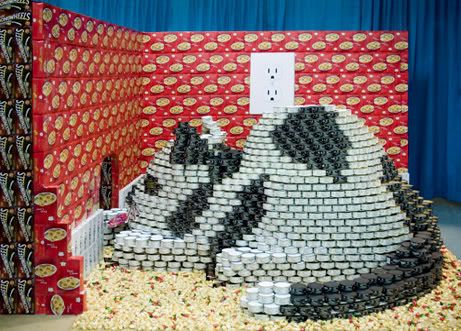
I love adventures. Yesterday, I had an awesome adventure with SJ and some other girls in NYC. First, we went to this random building that hosts many different architecture and design firms. They were having a charity fund raiser there where you had to donate a can of food in order to enter. Once inside, the offices in the various floors had sculptures made almost solely out of food cans. It was a contest and each firm had a sculpture which they'd had a day to make a week earlier. It was incredible. There were polar bears, Kermit the Frog, race cars, ice cream cones, DNA strands, and, most impressive of all, the Mona Lisa - all made out of cans. Each sculpture had a punny name like deCANstruction or other things like that which I cannot remember now.
At night, we went to see the movie Enchanted.
It was incredible.
It made us all feel so happy, I think. It's just that sort of movie. You walk out of there wearing a big smile. The story proves that there can be a happily ever after in the real world, even if life and love and everything aren't perfect - because in the real world, it can never really be perfect (as opposed to Andalasia where...well, I won't give anything away) but still, that doesn't mean people can't have fairy tale endings. It just isn't as simple as in real fairy tales, that's all. Anyway, it made me happy. Here's the preview, which is fun, too:
Anyway, happy Turkey Day, everyone!
Sunday, May 20, 2007
The Return to Adventure
Today, it being one of those damp, dreary, slightly rainy Shabbat afternoons, I spent the day curled up in my favorite chair in the living room reading. It was wonderful. It was in this state that I finished Neil Gaiman's Neverwhere, a sort of dark and dreary book itself, though in a wonderful, fantastic kind of way. Imagine Alice in Wonderland and the Wizard of Oz meeting the dankest of the London sewers, the hero entering a world which reveres rats and beasts that lurk underneath cities, where nearly no one is trustworthy and where your world is considered Below. This is Neverwhere, the place where those who fall through the cracks end up.
Aside from being an incredible read, Neverwhere made me realize something. I learned this year in my Myth and Folklore class about Campbell's theory of the monomyth. There is basically a cycle of events that usually occurs in the monomyth. There is katabasis, which is the call to adventure, the threshold guardian which the hero must defeat before entering the adventure, the helpers and trials and tests along the way, the threshold guardian for the return, the return - where the hero comes home, usually with a boon of some sort -, at one-ment with the Mother Goddess/female figure, reconciliation/reunification with the father/father figure.
This theory works wonderfully in those tales which end at the very close of the adventure, leaving the reader with the famous, "and they lived happily ever after. The end." But did you ever find yourself wondering if they really lived happily ever after? How can that be the true end? Has the life of the protagonist been complete? No. So what happens after that?
Neil Gaiman in his book adds two more elements to Campbell's theory; elements which I feel are extremely important and which add so much depth to the character and to the story. These are 1. a dissatisfaction with the world the hero returns to/realization the hero has changed and no longer belongs in his original world and 2. the return to adventure.
The hero in Neverwhere, a London dwelling Scotsman named Richard Mayhew, returns to London Above after having spent many trials and tribulations in London Below. The trials and tribulations, however, have actually just been growing pains for Richard, who comes out of London Below a new person. He has newfound confidence and maturity. If the analogy to The Wizard of Oz were to be made, he returns as the Cowardly Lion Who Has Now Got His Courage. He has learned that there is so much more to life than the everyday getting up, going to work, coming home, going to sleep, getting up, going to work, coming home, going to sleep routine. Unable to find meaning in his old, comfortable life, Richard chooses to return to the land which forced him to grow up and become a true man, regardless of the fact that he was technically a full-grown man from the start. He chooses to return to hardship, to trials, to tests of his courage and stamina, to the place where everything dark and foul lives, because it is there where he finds excitement, surprise, adventure, meaning. In London Below, things actually matter, choices matter, who you associate with matters. And because of this, this land in the sewers of London, this land between the cracks, is the true happily ever after for Richard Mayhew.
It is this sort of happily ever after that I feel really rounds out a story. Because if you think about it, it's true in real life as well. Whenever a person goes through an experience which greatly changes him, he finds it difficult to find meaning in his old way of life. He cannot go backwards, only forwards. You can never really return. I guess that's my point. You may be able to physically go back to where you came from, but you can never really go back to the way things were. Not if you live life linearly. There is no going back. Only forward. And this is why the adventure story, the hero story, cannot always end with the return home. That is not the true ending of the story. It is being cut off before it reaches its finish. The true end is the realization that life cannot go on backwards. Only forward. The hero cannot return home mentally and emotionally, for he has changed. He is a different person than he was when he started out, when he had his katabasis, when he first met that initial threshold guardian.
Look at Beowulf. He had his adventure. He defeated Grendel. He defeated Grendel's mother. And then he went home, yes, and eventually was made king. But did he stop? Did he say, "And then I lived happily ever after. The end." No! He didn't! He went and fought a dragon. Because he was a hero and heroes can only go forward, not back. He couldn't return home and be regular Beowulf like before. He couldn't even go home and be King Beowulf. No, he had to be King Beowulf the dragon slayer right 'til the end. He had to return to adventure.
And this is my point. The return home is not enough. To end a story there is cheating the hero. There is more, the hero now must lead the life of a hero. He must return to adventure.
And then he is truly living happily ever after. For can a hero truly be happy when he is not being a hero?
Aside from being an incredible read, Neverwhere made me realize something. I learned this year in my Myth and Folklore class about Campbell's theory of the monomyth. There is basically a cycle of events that usually occurs in the monomyth. There is katabasis, which is the call to adventure, the threshold guardian which the hero must defeat before entering the adventure, the helpers and trials and tests along the way, the threshold guardian for the return, the return - where the hero comes home, usually with a boon of some sort -, at one-ment with the Mother Goddess/female figure, reconciliation/reunification with the father/father figure.
This theory works wonderfully in those tales which end at the very close of the adventure, leaving the reader with the famous, "and they lived happily ever after. The end." But did you ever find yourself wondering if they really lived happily ever after? How can that be the true end? Has the life of the protagonist been complete? No. So what happens after that?
Neil Gaiman in his book adds two more elements to Campbell's theory; elements which I feel are extremely important and which add so much depth to the character and to the story. These are 1. a dissatisfaction with the world the hero returns to/realization the hero has changed and no longer belongs in his original world and 2. the return to adventure.
The hero in Neverwhere, a London dwelling Scotsman named Richard Mayhew, returns to London Above after having spent many trials and tribulations in London Below. The trials and tribulations, however, have actually just been growing pains for Richard, who comes out of London Below a new person. He has newfound confidence and maturity. If the analogy to The Wizard of Oz were to be made, he returns as the Cowardly Lion Who Has Now Got His Courage. He has learned that there is so much more to life than the everyday getting up, going to work, coming home, going to sleep, getting up, going to work, coming home, going to sleep routine. Unable to find meaning in his old, comfortable life, Richard chooses to return to the land which forced him to grow up and become a true man, regardless of the fact that he was technically a full-grown man from the start. He chooses to return to hardship, to trials, to tests of his courage and stamina, to the place where everything dark and foul lives, because it is there where he finds excitement, surprise, adventure, meaning. In London Below, things actually matter, choices matter, who you associate with matters. And because of this, this land in the sewers of London, this land between the cracks, is the true happily ever after for Richard Mayhew.
It is this sort of happily ever after that I feel really rounds out a story. Because if you think about it, it's true in real life as well. Whenever a person goes through an experience which greatly changes him, he finds it difficult to find meaning in his old way of life. He cannot go backwards, only forwards. You can never really return. I guess that's my point. You may be able to physically go back to where you came from, but you can never really go back to the way things were. Not if you live life linearly. There is no going back. Only forward. And this is why the adventure story, the hero story, cannot always end with the return home. That is not the true ending of the story. It is being cut off before it reaches its finish. The true end is the realization that life cannot go on backwards. Only forward. The hero cannot return home mentally and emotionally, for he has changed. He is a different person than he was when he started out, when he had his katabasis, when he first met that initial threshold guardian.
Look at Beowulf. He had his adventure. He defeated Grendel. He defeated Grendel's mother. And then he went home, yes, and eventually was made king. But did he stop? Did he say, "And then I lived happily ever after. The end." No! He didn't! He went and fought a dragon. Because he was a hero and heroes can only go forward, not back. He couldn't return home and be regular Beowulf like before. He couldn't even go home and be King Beowulf. No, he had to be King Beowulf the dragon slayer right 'til the end. He had to return to adventure.
And this is my point. The return home is not enough. To end a story there is cheating the hero. There is more, the hero now must lead the life of a hero. He must return to adventure.
And then he is truly living happily ever after. For can a hero truly be happy when he is not being a hero?
Subscribe to:
Posts (Atom)
