This is not a long post, nor is it a deep, thought provoking one. I am writing this post mainly to get over my glee of driving to the Five Towns for the first time IN THE DARK. BY MYSELF. AND ON THE WAY BACK, I REMEMBERED TO PUT ON MY LIGHTS AFTER ONLY TWO MINUTES OF DRIVING. AND I DID NOT GET LOST. Wait, wait. Let's make a list:
Accomplishments for Tonight
1. Driving to the Five Towns by myself
2. Driving in the dark by myself
3. Remembering to put on my lights on the way there, and only forgetting to turn them on in the beginning of the way back
4. Not getting lost
5. Knowing my rights from lefts
6. Successfully avoiding the highway even when the GPS told me to go there
7. Making it home in one piece and in a normal amount of time
YOU SHOULD ALL BE SUPER PROUD OF ME.
Sunday, March 23, 2008


Tuesday, March 18, 2008
Wicked Fun
I know I haven't updated in a while - especially not a real update - but I'm going to cheat a little and use some fun youtube videos as an excuse for posting. But they're not just fun, they're wicked fun! And...they're all from Wicked! Wicked is probably my favorite musical ever, tied with Les Miserables. I saw it twice (the first time really early on with the original cast and the second time SJ and I won the show lottery and got front row seats). And so, for your entertainment tonight, we have...
Kristin Chenoweth's last performance of the song Popular. Check out what goes on starting from 5:30. I've seen this show twice and I'm positive that part was added in as a special thing for Kristin Chenoweth's last night. rated: HILARIOUS.
This is an absolute tear-jerker. It's also from Kristin Chenoweth's last night. It keeps reminding me of all the awesome bonding that I keep missing that happens when you're in a show. :(
And this is absolutely hilarious. REAL, LIVE BLOOPERS. See, things can go wrong even in a Broadway musical. We just all have to learn to deal with the things life sends our way. And hopefully, we're all a little bit good at improv, too. :D
This last one is dedicated to all my friends who read my blog (you all know who you are...you're probably the only ones reading at this point, anyway :P). Yeah, it's sappy, but there's never a wrong time to let you all know how much I appreciate you and how much you guys have influenced me. So! Let the sap begin:
Thank you all for being such a great audience! *bows* *exits stage left*
Sunday, March 9, 2008
This is for the English majors and other word-lovers:
Mary Poppins:
When trying to express oneself, it's frankly quite absurd,
To leaf through lengthy lexicons to find the perfect word.
A little spontaniaty keeps conversation keen,
You need to find a way to say precisely what you mean...
Supercalifragilisticexpialidocious!
Even though the sound of it is something quite atrosicous!
If you say it loud enough, you'll always sound precocious,
Ensemble:
Supercalifragilisticexpialidocious!
Um-diddle-diddle-um-diddleye
Um-diddle-diddle-um-diddleye
Mary Poppins:
When Stone Age men were chatting, merely grunting would suffice.
Bert:
Now if they heard this word, they might have used it once or twice!
Mrs. Corry:
I'm sure Egyptian pharoahs would have grasped it in a jiff,
Then every single pyramid would bear this hieroglyph;
Oh!
Supercalifragilisticexpialidocious!
Say it and wild animals would not seem so ferocious!
Mary Poppins:
Add some further flourishes, it's so ro-co-co-coscious!
Ensemble:
Supercalifragilisticexpialidocious!
Um-diddle-diddle-um-diddleye
Um-diddle-diddle-um-diddleye
Um-diddle-diddle-um-diddleye
Um-diddle-diddle-um-diddleye
Bert:
The Druids could have carved it on their mighty monoliths!
Mrs. Corry:
I'm certain the ancient Greeks would have used it in their midst!
Mary Poppins:
I'm sure the Roman Empire only entered the abyss,
Because those Latin scholars never had a word like this!
Ensemble:
Supercalifragilisticexpialidocious!
Mary Poppins:
If you say it softly the effect can be hypnoscious!
Bert:
Check your breath before you speak, in case it's halitotious!
Ensemble:
Supercalifragilisticexpialidocious!
Um-diddle-diddle-um-diddleye
Um-diddle-diddle-um-diddleye
Um-diddle-diddle-um-diddleye
Um-diddle-diddle-um-diddleye
Mary Poppins (spoken):
Of course you can say it backwards, which is Suoicodilaipxecitsiligarfilacrepus!
Michael (spoken):
She may be tricky, but she's bloody good!
Mary Poppins:
So when the cat has got your tongue, there's no need for dismay!
Just summon up this word and then you've got a lot to say!
Bert:
Pick out those eighteen consonants and sixteen vowels as well,
And put them in an order which is very hard to spell...
Mary Poppins:
S-u-p-e-r
C-a-l-i-f-
R-a-g-i-l-
Jane and Michael:
I-s-t-i-c-e-x-p-i-a-l-i-d-o-c-i-o-u-s!
Ensemble:
S-u-p-e-r
C-a-l-i-f-
R-a-g-i-l-
I-s-t-i-c-e-x-p-i-a-l-i-d-o-c-i-o-u-s!
S-u-p-e-r
C-a-l-i-f-
R-a-g-i-l-
I-s-t-i-c-e-x-p-i-a-l-i-d-o-c-i-o-u-s!
S-u-p-e-r
C-a-l-i-f-
R-a-g-i-l-
I-s-t-i-c-e-x-p-i-a-l-i-d-o-c-i-o-u-s!
Bert (spoken):
Here we go!
Supercalifragilisticexpialidocious!
Even though the sound of it is something quite atroscious!
If you say it loud enough, you'll always sound precocious,
Supercalifragilistic-
Jane and Michael:
Supercalifragilistic-
Ensemble:
Supercalifragilisticexpialidocious!
Supercalifragilisticexpialidocious!
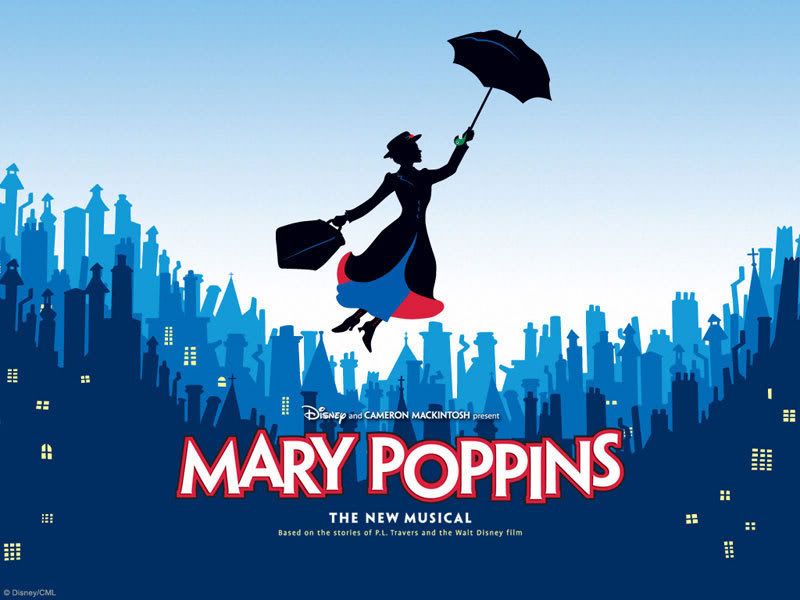
As you might have guessed, I saw Mary Poppins today on Broadway and it was spectacular. It wasn't Les Miz, it wasn't Wicked, but it was definitely an amazing show. I absolutely loved the way it didn't try to copy the movie but instead went completely in its own direction. I think when you're competing with something as classic and legendary as the Mary Poppins movie, and especially a production by Julie Andrews, it's best to do your own thing and to reinterpret the story and the roles in a way that makes it your own as opposed to trying to mimic the greats. Mimicking will get you nowhere aside from comments like, "she was good, but not Julie Andrews" or "it was fun, but it wasn't the movie." I actually found Ashley Brown's (the actress) portrayal of Mary Poppins to be COMPLETELY different from the one characterized by Julie Andrews, and it worked well. Gavin Lee, who played Bert, did seem like he was modeling himself after Dick Van Dyke, but that worked just fine anyway. I think that particular role does work best the way Dick Van Dyke did it and Gavin Lee was good enough to pull it off. I was sad about the noticeable (for me) absence of the suffragette song, but there were enough fun, new songs and new scenes that made it a great show, anyway. It was based a lot more on the books than the movie, which was a nice move on their part. Also, fun fact for SJ, Ashley Brown ALSO played Belle on Broadway. :D
Highly recommended if you're in the mood for some good, quality fun!
Why I could not write about the terrorist attack at Mercaz Harav
There are so many amazing posts out there about people's reactions to the tragedy at Mercaz Harav. So why did I not contribute? Why did I direct my attention elsewhere? Why did I write about other things and not about the one thing that truly deserved to be written about - that called out to every one of us, begging us to write?
Maybe it's because what happened at Mercaz Harav is too tremendous for me to have coherent thoughts which I can actually type out. I'm sad, I'm upset, I'm distraught, even, but I can't add to what has already been written unless I reiterate the way this event has struck me and the rest of Am Yisrael. But who needs reiteration?
Mercaz Harav is a place many Americans know, so it is not a surprise that the attack there elicited such a strong reaction from the Jewish American community. But for me, instead of wanting to cry out, instead of transcribing my emotions to paper as I do on occasion, I turned inward. I became extremely introspective and have been barely able to address this issue in a somewhat coherent fashion until right now, and even now I don't know what I'm supposed to say. It helps no one to start describing the feelings of despair - not when everyone else is feeling it.
And yet, I feel as though if I don't write about the event, I'll be overlooking it. So perhaps this counts as my obligatory post on the tragedy of Mercaz Harav. Or perhaps it does not. Perhaps it's a cop-out, because I'm not really writing about the event itself, but rather, I'm writing about writing about it.
I hope you all understand why I could not write a post sufficiently describing the pain Am Yisrael is going through and why I could not contribute to the outcry. I just don't know how to do it. For me, I'm much more action-minded at times like these. Instead of mourning, I get angry. I want to teach all the terrorists a lesson. But since that is all fantasy, the only thing to do is try and deal with it the best I can, but the best I can seems to be not addressing the issue at all. Maybe I'm just afraid of crying or of anything that makes me feel uncomfortable. I don't know.
All I know is, now, more than ever, we need to mean it when we say Am Yisrael Chai.
And now I must return to grappling with the contradiction of Mi'shenichnas Adar Marbim B'simcha.
Adar sameach, everyone.
A Defense of Art, Part 2, or More on the Trashy Novel Stuff
The Apple was so kind as to email me this article from the New York Times. Instead of providing a link, I just copied and pasted the whole thing, you if you want the link, it's here.
Great Literature? Depends Whodunit IN a British court recently, an author said, in effect, that glue-sniffing had made her write a thriller. The author, Joan Brady, is a 68-year-old American who has lived in England for the last several decades and in 1993 became the first woman to win the Whitbread book prize. She received a £115,000 out-of-court settlement after arguing that fumes from the glue and solvents used in the Conker shoe factory next door to her home in Totnes had poisoned the air and made her sick. She suffered nerve damage, she said, and a loss of concentration that caused her to abandon the literary novel she was working on, “Cool Wind From the Future,” and instead crank out a potboiler called “Bleedout.”
“Fumes Made Me Go Lowbrow, Says Writer” was the headline in The Times of London, and Ms. Brady took exception, claiming that the voice in the new book was exactly the same as the one she had used in her highbrow Whitbread winner. You have to wonder, though, how many literary novels have flap copy like this, from “Bleedout”: “Even after Hugh Freyl lost his sight he was invincible. But late one night, in the library of the elite law firm that bears his name, he was beaten to death.”
You also have to conclude that Conker or its lawyers don’t know much about the publishing business — that is, if they really believed that Ms. Brady had suffered from turning to thrillerdom. Thrillers by and large do much better than literary novels, and though the title “Bleedout” turns out to refer, disappointingly, to kosher butchery rather than human carnage, it has done pretty well, selling some 50,000 copies in Britain alone since it came out in 2005. An author seeking damages would do better, one would have thought, by claiming to have become so addled that she had decided to forsake a certain payday for the vain hope of literary success. In that case the Times headline might read: “Fumes Float Author’s Fantasy.”
But what’s behind the Brady controversy, of course, is the assumption that genre fiction — mysteries, thrillers, romances, horror stories — is a form of literary slumming. These kinds of books are easier to read, we tend to think, and so they must be easier to write, and to the degree that they’re entertaining, they can’t possibly be “serious.”
The distinction between highbrow and lowbrow — between genre writing and literary writing — is actually fairly recent. Dickens, as we’re always being reminded, wrote mysteries and horror stories, only no one thought to call them that. Jane Austen wrote chick lit. A whiff of shamefulness probably began attaching itself to certain kinds of fiction — and to mysteries and thrillers especially — at the end of the 19th century, with the rise of the “penny dreadful,” or cheaply printed serial. The market and public appetite for this stuff became even larger in the early years of the 20th century with the tremendous growth of pulp magazines, which specialized in the genres and eventually even added a new one: science fiction.
Pulp writing, amply on display in “The Black Lizard Big Book of Pulps,” a new 1,000-page anthology edited by Otto Penzler, was often crude and formulaic, but it could also be thrillingly racy, taking on themes that politer fiction ignored, and eventually a few of the pulp writers — Raymond Chandler and Dashiell Hammett, for example — got promoted into the mainstream. The puzzling thing is that such promotions don’t happen more often. Both Ian Rankin, the British mystery writer, and Stephen King, the horror-meister, have complained about a double standard — a conspiracy, in effect — among critics and reviewers that tends to ghettoize genre writing and prevent its practitioners from being taken seriously.
But if there is a conspiracy it’s one that authors — highbrow authors, anyway — are sometimes complicit in, frequently adopting pseudonyms when they want to dabble in, say, crime writing. The most curious case recently is that of John Banville, the Booker Prize winner who has published two highly regarded mysteries under the name Benjamin Black but hasn’t taken any pains to keep his true identity a secret. For a Web site, he has even interviewed his alter ego. Perhaps not so surprising is that what makes the two Black novels, “Christine Falls” and “The Silver Swan,” so good — their atmospheric descriptive writing — is precisely Mr. Banville’s great strength, while Benjamin Black, whose third novel is currently being serialized in The New York Times Magazine, is still learning some of the ropes when it comes to plot and suspense.
The Black novels belong, in fact, to that interesting category of novels that are often said to “transcend” or “almost transcend” their genre. This compliment, however backhanded, used to be awarded all the time to John le Carré’s cold war thrillers. Mr. King hears it a lot now, especially from reviewers who want to imagine that he is gradually abandoning his horror roots. To transcend its genre, a book has to more nearly resemble a mainstream novel — it has to be less generic, in a word. A good example is the mysteries of P. D. James, justly praised for a characterization so rich and detailed that for long stretches you can forget you’re reading a crime story in the first place.
But is that always what we want — to forget why we’re reading what we’re reading? In a review a couple of years ago of a Robert Littell thriller, John Updike wrote about genre writers — Mr. le Carré and Ms. James included — who sometimes give signs of wanting to be “real” novelists and seem restive about living up to their implicit contract with the reader, which is to deliver on the promise that a particular genre entails — whether it’s a murder solved, a cold war plot thwarted, a horror unmasked, a love requited.
What we look for in genre writing, Mr. Updike suggested, is exactly what the critics sometimes complain about; the predictableness of a formula successfully executed. We know exactly what we’re going to get, and that’s a seductive part of the appeal. It’s why we can read genre books so quickly and in such quantity, and happily come back for more of the same by the very same author. Such books are reassuring in a way that some other novels are not.
Does that make them lesser, or just different? Probably both on occasion. But it doesn’t necessarily make them easier or less worthwhile to write. Henry James’s story “The Next Time” is a tragicomedy about Ralph Limbert, an author who desperately wants to be popular and write potboilers but can’t for the life of life of him manage, as the narrator says, to turn a silk purse into a sow’s ear. Like Ms. Brady, he even moves to the country, but without the benefit of fumes, he is doomed to being highbrow. The story is partly autobiographical, and not without a twinge of both snobbery and self-pity — James, too, wanted to be more popular than he was — but is also informed by a sense that for most writers there is no such thing as slumming. You write, by his lights, what you have a gift for writing; anything else will be revealed as fakery.
James talked a lot about “trash,” and whether he knew the difference between good trash and bad is doubtful. Yet he understood all about genre writing. “The Turn of the Screw,” one of the best things he ever wrote, is an unabashed ghost story.

Monday, March 3, 2008
A Defense of Art, Part 1
Yesterday, I went to see The Seagull by Chekov with my school. The general impression I got from that play was that art ruins your life, seeing as all the artists are miserable except for one really shallow person (who is also rather miserable, if you analyze her) and one ends up committing suicide.
After the play, we got to speak to the director and a bunch of the actors (including Alan Cumming - yay Scottish accent). I asked them about the message of the play and if there is a way to defend art based on that. The director said that art only ruins your life if you can't exist in art. Someone who is not willing to see art through for the sake of art, but more for the sake of themselves, will not make it. Only one whose true calling is art will survive.
I want to disagree. I want to disagree with the play as a whole, actually. Throughout the entire performance, we are never presented with a character who attempts it but is not good at art. I would have liked to have seen a talentless artist so I could see what that person's outcome would be. For me, the factor is not "can you exist without art in your life?" but rather "how much weight do you put on success?" If someone's true calling is not art but they decide to pursue some artistic endeavors anyway (such as acting, writing, etc.), that person can totally not let art get in the way of his happiness if his happiness is not dependent on the success of his art. In that respect, it's the exact opposite of what the director explained. Someone who puts the weight of his entire life and happiness on his art will never be satisfied. Then again, I suppose it depends why that person is creating art in the first place. If it is to please others, or worse, to please himself, he may never be satisfied, but if it is just to sell or just to create without concentrating so much on the end result, as in, doing it more for fun, then why should that ruin someone's life? Even if the person wants it to come out good, but creates art more to fulfill a desire of immersing himself in the art rather than anything else, I believe that person can still be perfectly happy.
Constantine's suicide is a result not of art, but of something much deeper. It is a reaction to his relationships and of the desire for acceptance from those who are distracted by other things. True, it is tied into art in that everyone else in the play is so preoccupied with one art form or another that they fail to see Constantine for who he is as a person and abandon him, but on the other hand, if that were not the case and Constantine were merely frustrated with his art, I don't believe he would have killed himself.
Basically, I'm frustrated with the play, with the message of the play, with the message of the director, and I am frustrated that I am coming down with a cold. Hmph.
Sleeping Meme

As I have been tagged (by Scraps) for this meme, I decided I might as well fill it out. After all, who doesn't love talking about oneself??? Btw, WHO RECOGNIZES THIS PICTURE??? Yay childhood!
1. How much sleep do you get on an average night?
Somewhere between 6 and 8, though usually closer to 6.
2. Is that enough sleep for you?
No. Nothing is ever enough sleep for me.
3. At what time do you normally go to sleep and wake up?
I usually go to sleep around 2 every night, give or take a half an hour. I wake up always around five, five thirtyish, go back to sleep, and my alarm wakes me again at 8. Er, I get out of bed sometime after that.
4. Do you usually fall asleep right away or have trouble?
It depends how exhausted I am. I tend to sleep better in school than at home (weird, no?) so at school, I fall asleep almost right away (especially if I'm reading). At home, I toss and turn a bit more and wake up more frequently during the night.
5. What size bed do you have?
Twin.
6. How many pillows do you use?
Two, and at home I also use a stuffed yellow dog as a sort of third pillow.
7. In what position do you sleep?
All different positions (I toss and turn a lot before I fall asleep, though I generally don't move around once I'm sleeping. I know this because I've woken up after eight hours with my hand still holding open a book). My favorite is all curled up in a fetal position, though.
8. Do you need it to be quiet or dark to sleep?
No way. If I'm tired enough, I can fall asleep anywhere. It actually unsettles me when it's TOO quiet and TOO dark, so I'm less likely to fall asleep in those conditions. I like low background noise and soft darkness (as in, a little bit of light but not glaring light). My favorite conditions for falling asleep, oddly enough, are in the early morning when natural light is coming in through the window shades, giving the room a cool, blue look. I also like it when it actually IS a bit cool. I fall asleep better in the cold than in the heat.
9. Do you use earplugs or an eye mask?
Never. Ew.
10. Have you ever used a sleeping aid long-term?
Nope.
11. Do you use headgear, a night retainer, or a biteplate?
Erm. I own a retainer.
12. What do you normally wear to bed?
T-shirt and light pants (or shorts, in the summer). Unless the heat is broken in my dorm room and it's utterly freezing, in which case I wear a t-shirt, sweatshirt, and sweatpants.
13. Do you frequently fall asleep in your clothing?
No, never, unless it's the middle of shabbat afternoon and I'm reading and fall asleep by accident. Otherwise, I DETEST sleeping in my clothing. Clothing is for being awake, pajamas are for sleeping. Sleeping gear may NEVER be worn while awake and doing things. Ew.
14. Do you prefer a heavy or light blanket?
Depends on how cold/hot it is. I prefer heavy to light, I think, because I like cuddling up under my blanket and it's easier to do that if it's thicker.
15. Do you prefer warm or cool PJs?
COOL.
16. Do you wear socks to bed?
Never, never, never. Your feet need to BREATHE, people! I never wear anything to bed that will make me wake up sweaty. EW.
17. What is your bedtime routine?
Check my email, take out contacts, get in pajamas, get a drink of water, get in bed, read until I fall asleep. Sometimes, if I'm too tired to read, I'll just take a book and have it to fall asleep with. Like, instead of a teddy bear. I don't know why, but especially when I can't fall asleep, that seems to help. It helps even MORE if I actually OPEN the book and hold it open while falling asleep, even if I don't read one word. I'm weird, sometimes.
18. Do you listen to music when you’re falling asleep?
I went through a phase in high school and Israel when I did that, but I stopped and I don't think I'd go back to it. I like to actually listen to the songs too much, plus having headphones in my ears while falling asleep isn't very pleasant.
19. Have you sucked your thumb in recent years?
Not in recent years, no. But as a kid - BIG TIME. I was a HUGE thumb sucker until about kindergarten, or even first grade.
20. Do you still sleep with your childhood blankie/teddy?
YES. But it's not a blankie OR a teddy. It's a yellow dog named Yellow Doggie. I got my naming skills from Adam and Chava so shh. Adam saw a dog, he named it Dog. I saw a yellow dog, I named it Yellow Doggie. SAME THING.
21. Do you snore?
Ugh, no. I suppose if I'm sick I might breathe heavily, but that's it.
22. Do you sleeptalk or sleepwalk?
I've been told I sleep talk sometimes, but not really. I definitely don't sleep walk. Sometimes I feel myself laughing at my dreams, though. I dunno what you'd call that - a sleep laugh? I'm usually about to wake up when that happens, though.
23. Do you wake up to use the bathroom often?
Not every night, but pretty often. Usually once a night.
24. What things inhabit your bed aside from a blanket and pillow?
Me, yellow doggie (when I'm at home, Doggie doesn't come to school because I don't want to have to wash him from Dorm Germs. He's too fragile), sometimes a book.
25. What kind of alarm clock do you use?
At home I have a clock radio, but in school I use an iHome.
26. Do you ever wake up before your alarm?
Almost always, unless I'm in a deep, well-rested sleep. I usually wake up about five or ten minutes before my alarm clock.
27. Do you frequently take naps?
Never. I hate naps. I hate sleeping during the day. It's disorienting and then I'd have to wash up ALL over again because I need to wash my face and brush my teeth every time I wake up, even from a nap. Also, I don't like sleeping in my contacts. Can you tell I'm rather anal about this sleeping stuff?
28. Have you ever slept ‘under the stars’?
YES! It's the best experience EVER. At a certain point at camp, I got sick of sleeping in the claustrophobic tents and spent every camp out sleeping outside. I love it. Well, unless it's raining.
29. Can you fall asleep on a bus, train, or airplane?
Yes, but I HATE it. EWWWWWW.
30. Have you ever fallen asleep and missed your stop?
Nope.
And last, but not least,
31. Over the course of a lifetime, the average person swallows six spiders in his/her sleep. How many do you think you're up to?
NONE. I refuse to acknowledge that I have been swallowing spiders in my sleep. YUCK, EW, GROSS!
I tag anyone who hasn't been tagged yet.
Subscribe to:
Posts (Atom)
